
Mineral Substrates
- Concrete
- Plaster
- Masonry
- Screed / cement
- Tiles
- Natural stone
Subject to inspection and compatibility assessment.
Our waterproofing system
We work with a professional PU-hybrid build-up applied in defined layers. The result depends on three things: the right system for the project, correct surface preparation, and disciplined application including all details.
System structure
Substrate preparation comes first, then a fiber-reinforced polyurethane-hybrid build-up. Fleece reinforcement is not required by the fiber-reinforced system — we use it as an additional layer of protection in our premium build-up.
Tap a layer · drag to rotate
Proper waterproofing starts before the first coat.
Waterproofing a damaged substrate without treating the underlying cracks is not a proper long-term solution. Cracks move — they need to be treated before they are sealed. Just like a dentist treats the problem before sealing it, we treat and repair cracks before applying the waterproofing system.
Fiber-reinforced waterproofing already provides integrated reinforcement. At Cleanja Prestige, we can go one step further — adding a fleece reinforcement layer as an additional protection measure for selected premium applications.
Built for protection. Designed for longevity.
Build-up selected per project after substrate assessment.
Substrate condition, moisture, compatibility and preparation must be assessed before any system is selected or applied.
The system is not automatically suitable for every surface. Suitability is confirmed project by project.
Fire-performance options depend on the selected system and product. An optional white reflective finish can be included.
System build-up
The documented system variants follow a defined sequence. Each stage is confirmed project by project.
Substrate
Assessed for condition, moisture and compatibility
Primer / scraper
When required
Waterproofing membrane
Liquid-applied PU-hybrid
Reinforcement / fleece
Where required
Protective / top layer
Where specified
Specification
Values are taken from the underlying technical assessment and laboratory documentation for the documented system variants.
Liquid-applied 2K PU-hybrid waterproofing system
3.0 kg/m² for the documented standard system
3.7 kg/m² for the documented “+” system
2.1 mm for the documented standard system
2.0 mm for the documented “+” system
W3 — 25 years
M and S — moderate and severe climate
TL4 — -30°C
TH4 — +90°C
Passed
≥ 50 kPa for tear-resistant substrates
≥ 3 mm at ≥ 2 mm dry layer thickness
Documented μ-values approximately 2155–2748 depending on system variant
Additional laboratory testing
The system has undergone laboratory testing after exposure to kerosene vapour and liquid kerosene.
21 days
Kerosene exposure
2.0 g/m³
Kerosene mass concentration
For the documented vapour exposure condition
Tensile test comparison · discrete tested conditions
Normal conditions
1.44 MPa · 46.2%
Mean tensile strength 1.44 MPa · mean elongation at maximum tensile strength 46.2%
Kerosene vapour
1.29 MPa · 48.9%
Mean tensile strength 1.29 MPa · mean elongation at maximum tensile strength 48.9%
Liquid kerosene
1.13 MPa · 47.5%
Mean tensile strength 1.13 MPa · mean elongation at maximum tensile strength 47.5%
Bars represent the three discrete tested conditions only. No performance is implied for other concentrations, exposure periods or temperatures.
Documentation
We do not just sell waterproofing. We deliver a documented system, specialist application and professional site execution. The references below belong to the underlying system documentation — Cleanja Prestige is neither the issuing laboratory, the certification body nor the manufacturer of the underlying technology.
European Technical Assessment
ETA-22/0177
Reaction to fire classification
EN 13501-1
External fire performance
EN 13501-5
BROOF(t4)
Documented classification
Extended application testing
According to the applicable CEN/TS framework
Laboratory kerosene exposure testing
Vapour and liquid exposure
DIN EN ISO 527-1
Tensile testing
DIN EN ISO 2808
Dry film thickness testing
Technical performance is based on the underlying laboratory reports and European technical assessment documentation. Results apply to the tested systems, assemblies, products, application conditions and test parameters described in those documents. Project-specific engineering review, substrate assessment, authority requirements and manufacturer/application instructions remain applicable.
Two system configurations
Which configuration we specify depends on the project. Both are cold-applied PU-hybrid systems — the difference is how the reinforcement is achieved.
System 01
Build-up follows the manufacturer system reference. The final specification is confirmed after substrate assessment.
Variant B build-up
Technology explained
A liquid component and a powder component react together to form a seamless, crack-bridging waterproofing membrane — applied cold, without open flame.
Technical values are manufacturer / system information and relate to the tested configuration and stated test conditions.
Product characteristics · MB PUReactive+
Fire and roof classifications depend on the tested system build-up and substrate configuration — they are not universal for every roof.
PU-hybrid technology
MB PUEreactive+ / PU-hybrid waterproofing technology provides a liquid-applied solution for professional roof waterproofing and regeneration applications.
Where technically suitable and after proper substrate preparation, the system can be used over existing waterproofing substrates such as bitumen, PVC and EPDM where compatibility has been confirmed.
Work with a suitable existing waterproofing layer instead of removing it.
A continuous liquid-applied barrier including upstands and details.
Support the service life of the existing roof build-up where technically appropriate.
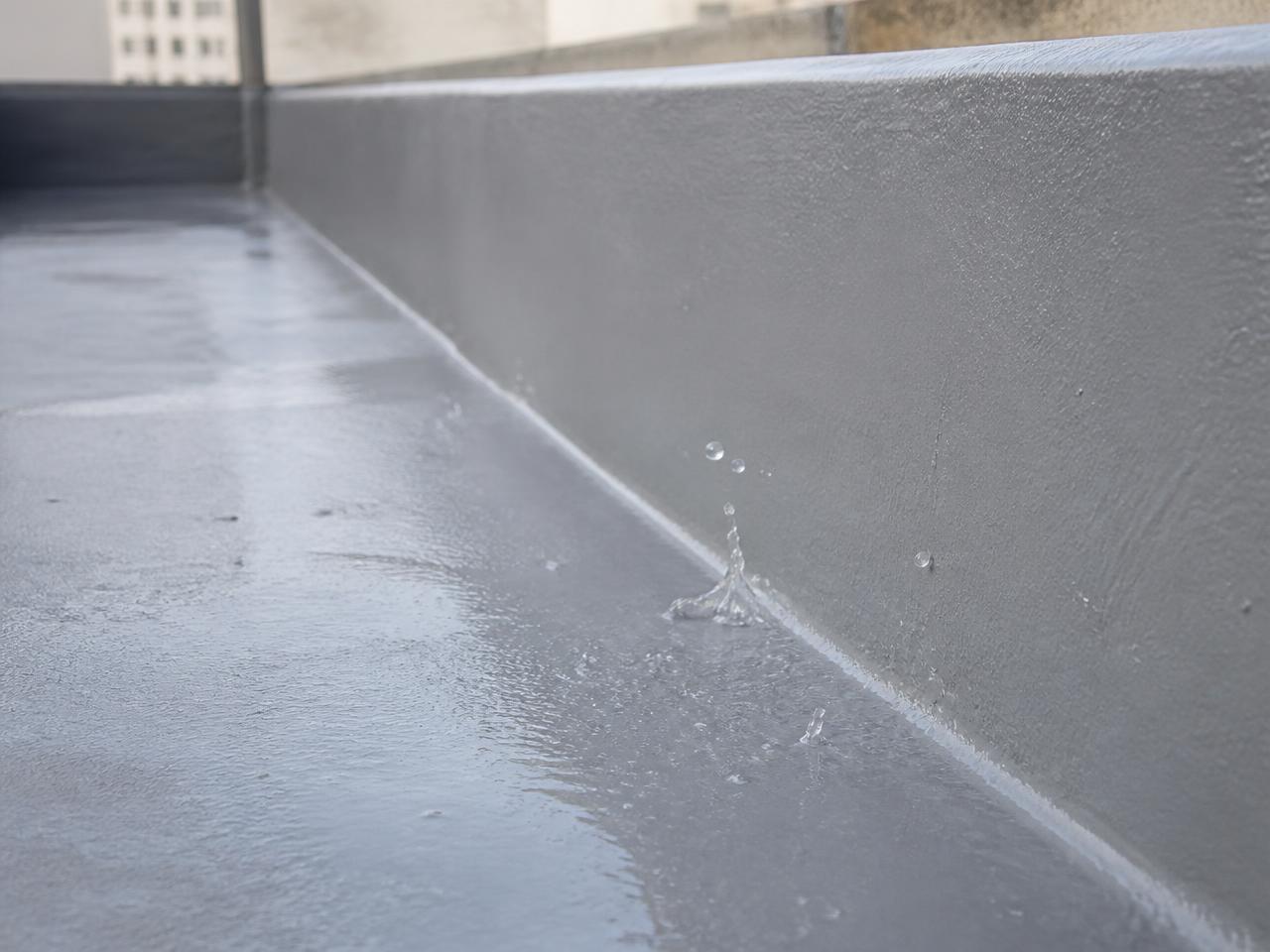
Detail work
Most roof problems do not start in the middle of the surface. They start at the details — where the roof meets a wall, a door threshold, an upstand or a drain.
Waterproofing details should be properly extended up the vertical surface into the splash-water zone where the construction detail and project conditions require it.
The horizontal and vertical areas are connected as one continuous layer, so splashing water has no open joint to travel through.
The required height and detail solution depend on the specific construction detail and the applicable specification for the project — it is defined during inspection, not assumed.
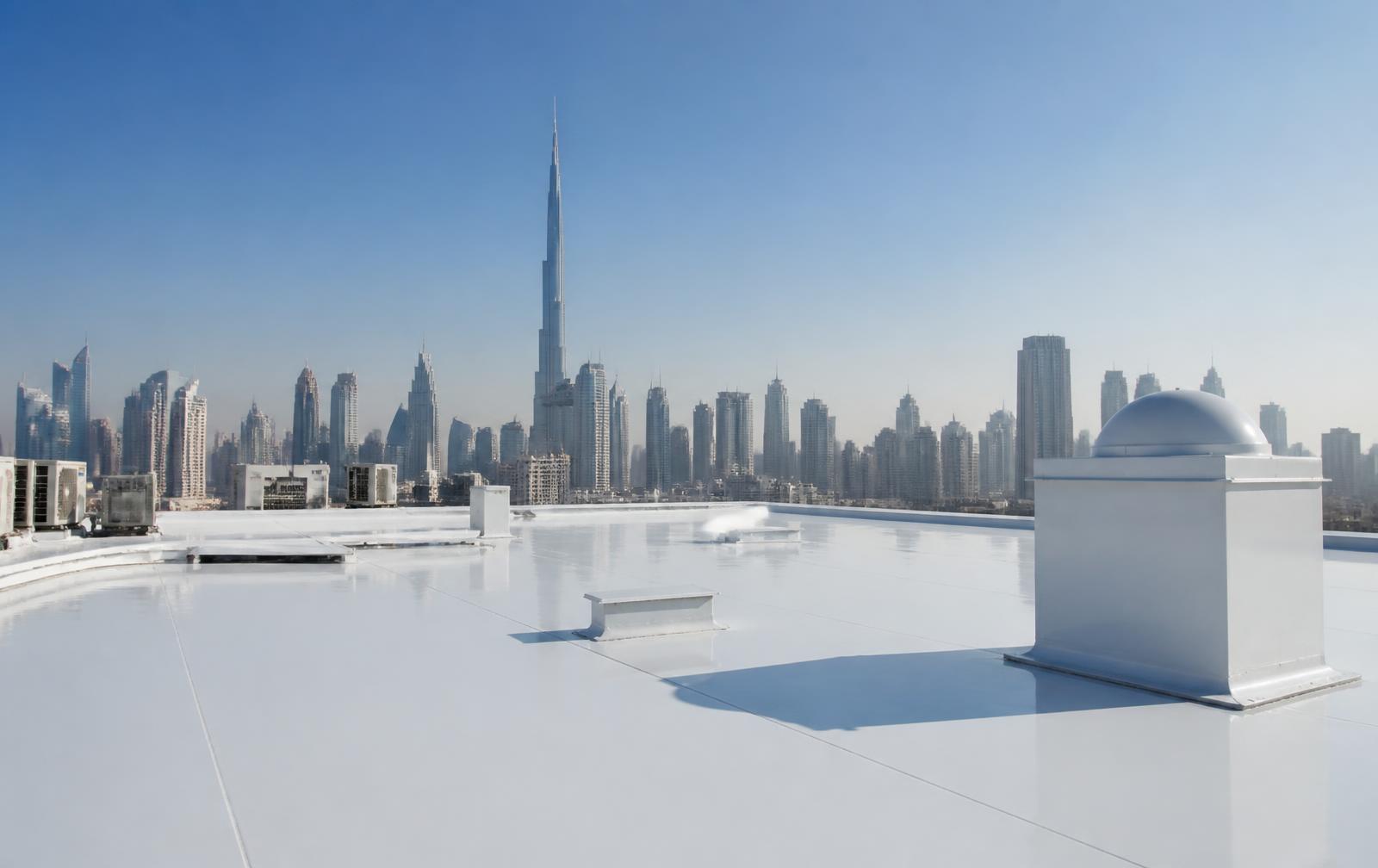
White finishing system
A white reflective finish can help reflect solar radiation and reduce heat absorption at the roof surface.
This can support thermal comfort and potentially reduce cooling demand, depending on the building, roof construction, climate and operating conditions.
Intense solar radiation on the roof surface.
A light, clean finish reflects part of the incoming radiation.
Lower surface heat build-up on the roof.
Fire performance
Cold-applied waterproofing can provide an alternative to waterproofing applications involving open flames or high-temperature torch work.
Traditional hot work
Cold-applied system
No open flame
Low application heat
Professional application
Tested performance
B-s1,d0
Reaction-to-fire classification
BROOF(t1–t4)
External fire performance of roofs
CLC/TR 50670
Technical reference for roof-mounted PV applications
Fire-performance classifications apply to the specific tested system and application conditions. Refer to the relevant technical documentation.
Regeneration
Existing waterproofing does not always need to be completely removed. Depending on the existing substrate and system requirements, MB PUReactive+ can be applied directly over suitably prepared existing waterproofing systems such as bitumen, PVC or FPO.
Proper preparation and assessment are essential. Substrate condition, moisture, adhesion and compatibility are checked before any regeneration is proposed.
Regeneration instead of full replacement
Extended service life of existing waterproofing
Efficient application
Reduced disruption to the building in use
Cold application — no open flame
Suitable for demanding renovation situations
Bitumen, PVC, FPO or an ageing liquid system in place.
UV exposure, thermal movement and detail fatigue reduce performance.
Assessment, preparation and cold-applied PU-hybrid waterproofing on top.
A continuous new barrier protecting the existing build-up.
At a glance
No torch-based application.
Seamless application where correctly specified and installed.
Fiber-reinforced material, with optional additional fleece reinforcement where specified.
Suitable existing systems can potentially be regenerated.
Tested characteristics according to technical documentation.
White finishing systems can provide solar reflectance benefits.
Substrate categories
The following categories give an overview of surfaces that can generally be considered. Every surface still requires inspection and a compatibility assessment before application.
Subject to inspection and compatibility assessment.
Subject to inspection and compatibility assessment.
Subject to inspection and compatibility assessment.
Subject to inspection and compatibility assessment.
Subject to inspection and compatibility assessment.
Manufacturer / system certifications
The following management-system standards are associated with the system / manufacturer we work with. They are shown as system and manufacturer information.
DIN EN ISO 9001
Quality management
DIN EN ISO 45001
Occupational health & safety
DIN EN ISO 14001
Environmental management
ISO certification documentation is provided on request. The waterproofing materials used by Cleanja Prestige are ISO certified.
Cleanja Prestige · Dubai · Abu Dhabi · UAE
Professional assessment. Advanced waterproofing technology. German construction experience. Long-term protection.